Friday, May 24, 2013
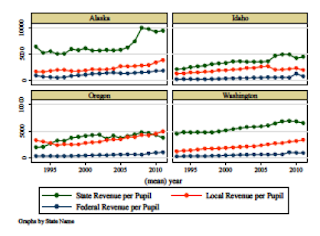
Picture of the Day: Falling Investment in Education
From the Wall Street Journal:
U.S. public-education spending per student fell in 2011 for the first time in more than three decades, according to new U.S. Census Bureau data issued Tuesday.
Thursday, May 23, 2013
Soccernomics: Principal-Agent Models and Options, MLS Style
![]() |
| Image credit: AFP/Getty Images |
Forbes has a piece on-line that describes David Beckham's 'windfall' now that Manchester City FC and the New York Yankees have teamed up to purchase the franchise rights for an MLS team in New York City for $100 million:
As part of his deal with MLS when he played for the Los Angeles Galaxy, Beckham was given the right to buy an MLS expansion team for $25 million. The league has confirmed that Beckham has been having discussions with MLS recently about doing just that. Grabbing an MLS team for $25 million would be a huge windfall for the 38-year old Beckham.This type of option contract is familiar in the corporate world where companies are eager to link executive pay to company performance to avoid moral hazard problems familiar in principal-agent situations. For example the CEO taking decisions that benefit themselves personally but harm the long-term profit of the company. The problem with these in the corporate world is that they have created a myopia among some CEOs who are eager to drive the stock price up in the short-term and cash out disregarding the future profits of the company. A classic example is the CEO who cuts costs and increases profitability by eliminating the R&D division. Good for now, but what happens when the new products dry up?
But I digress. My point is that MLS was not just sweetening the pot when it offered Beckham the option of buying into the league for $25 million, it was giving Beckham a big incentive to care about the long term health of the league which depended more than a little in how he behaved post contract. It would be interesting to know who first proposed the option: the MLS or Beckham but it seems a reasonable way to align incentives and help ensure the visibility and reputation of the league.
All of this suggests why the MLS has survived and is starting to show some real life: there are some savvy folks running the league...
Wednesday, May 22, 2013
Obama Wants More Infrastructure Investment, Will Democrats Go Along?
NOTE: Once more into the breach from Fred Thompson. The title refers to this piece by Kevin Drum.
I should acknowledge up front both that I am an
infrastructure enthusiast and that I think Keystone XL is a very smart
infrastructure project. Montana, North Dakota, and probably Alberta crude would
sell for $20 a barrel more than it does now if it could be cheaply transported
to Houston, Texas. A rough, quick and dirty calculation suggests that XL, which
will move 800,000 barrels a day at low cost, would generate about $6 billion in
net benefit per year; that’s a present value of approximately $120 billion
(i.e., the size of Oregon’s annual state product). But like all
big infrastructure projects Keystone XL has an environmental downside, in
this instance arguably a very big one. James Hansen, for example, asserts that
its effects would be both catastrophic and irreversible.
Most of the principled disagreement over the Keystone XL
pipeline appears to reflect different counterfactuals. By principled I mean
arguments that do not involve the rejection of anthropogenic climate change or
denial that prudence requires that we take the possibility
of catastrophe very seriously and take action to avert or, if that is not
possible, mitigate its dimensions.
The key counterfactual has to do with what will happen if
Keystone XL is not built. Opponents claim that the crude oil it would carry will
remain in the ground, resulting in a net reduction in the output of greenhouse
gases. Proponents believe that Canada’s tar sands will be exploited at more or
less the same rate whether XL is built or no.
Can we bring some simple economic thinking to bear on this
issue? Perhaps, but before that some context. First, nearly all of the crude
oil exported from Canada will be refined and consumed in the United States.
Second, most of the Canadian crude now consumed in the US comes here via
pipeline and is refined in Oklahoma, Missouri, and Illinois. Relatively small
amounts are shipped by rail, some all the way to Texas and New Jersey, but not
much. A handful of fairly small pipelines carry oil from Alberta through
British Columbia and Washington. Some of the crude they carry is refined in
Washington State but most of it is shipped on to California. Third, Keystone 3,
which runs from Oklahoma to Texas, will be completed this year. Consequently, because
the refineries there can process the Canadian stuff much more efficiently, a
lot of the Canadian crude now refined in Illinois and Oklahoma will soon go on
to Texas. Fourth, Canadian crude going to Texas will replace Venezuelan, Mexican,
and Nigerian crude that now arrives by ship. Expansion of the pipelines from
Alberta to British Columbia and Washington would replace oil from the Mideast
(where California gets most of the oil it refines).
Building Keystone XL also means that the crude oil produced
in North Dakota and Montana, the bulk of which is now moved by train to
refiners, would instead be transported by pipeline. Consequently, building
XL would have the immediate result of reducing the amount of crude transported
by rail in the US. Whether it would also forestall an increase in rail
shipments from Canada to the US is more iffy.
Initially, many of Keystone
XL’s opponents implicitly took the ‘no effect’ position. They argued that XL is
unneeded, that XL’s only effect would be to make the route traveled by crude
from Alberta to Texas less circuitous, and that existing pipelines and
railroads have more than enough capacity to move Canadian crude to the US: “Keystone XL’s
capacity won’t be needed until sometime after 2020 at the earliest and maybe
not until after 2030.” Consequently, most of the opposition focused on XL’s
threat to the Ogallala Aquifer and the environmentally sensitive Sand Hills
area of Nebraska. It was only after Keystone changed XL’s proposed route to
avoid the Sand Hills that opposition coalesced around the argument made all
along by XL opponent James Hansen that “If
this project gains approval, it will become exceedingly difficult to control … exploitation of tar sands [which] would
make it implausible to stabilize climate and avoid disastrous global climate
impacts.”
The crux of this claim is that extraction and use of fossil
fuels like oil and coal are directly related to the cost of
transport. “If a pipeline provides cheaper transport, it’s going to suppress
the cost of fossil fuels, prolonging their use. The cost of transport and the
price of fossil fuels cannot be separated.” With respect to oil from Alberta’s
tar sands, “the payoff from getting bitumen out of the sand is very low, it has
to be heated to make the oil flow. The acidity of the oil is high and it’s full
of stuff that no one wants to burn. Lacking the pipe line, there won’t be
enough margin to support moving the product by rail.” Clearly, at least some
opponents of the Keystone XL understand that the relevance of transportation
costs to the extraction and use of crude oil depends on whether its producers
are marginal suppliers or infra-marginal suppliers and by how much. If they are
marginal suppliers, transportation costs are critical, if they are infra-marginal
suppliers, not so much.
What is the weight of the evidence on this issue? My reading
of the evidence is that, at $50 a barrel, the tar sands would be marginal
suppliers. At $100 a barrel, exploiting this resource is a license to print
money, even if the cost to get it to refiners is >$20 a barrel. Right now
Alberta is an infra-marginal supplier. That is also the case with respect to
North Dakota and Montana. Of course, one can imagine contingencies in which things
would be otherwise. The price of oil could drop, for example, or, some time in
the future, producers may choose to exploit harder to access or process tar
sands. Clearly, there are circumstances in which transportation costs would affect
the exploitation and use of these resources, although it is hard to imagine
situations in which they would matter as much as the development of production technologies.
The bottom line is that success in the fight against greenhouse gases does not depend
in meaningful ways on this or any other infrastructure project.
What does the fight against greenhouse gases depend upon? The
enactment of measures such as carbon taxes, the payoff to investments in alternative
technologies, and, to a lesser extent, trade policy. How would a carbon tax
work? A carbon tax would drive a Investing in technologies that provide
substitutes for coal and petroleum: conservation, solar and wind power, nuclear
power, algal biofuel, even natural gas and methane hydrates, will further
reduce the demand for fossil coal and oil. That’s the next most important thing
we can do. At best, fights about infrastructure are sideshows; at worst, distractions
from issues that really matter in the fight against pollution and global
warming.
wedge between the
price paid by consumers and the price received by producers, reducing both
supply of (production) and demand for fossil fuels (consumption) and encourage
alternative, less carbon intense technologies. For example, a carbon tax of approximately
$50 a barrel would render Alberta a marginal supplier (assuming fixed
technology) and go a long way toward preempting more intensive exploitation of
this resource. It doesn't matter whether the tax is levied at the pump or on
the producer/importer and it most emphatically doesn't matter what you call it,
the incidence of an excise tied to carbon content would be the same, as would
the effects on consumption and production. Enacting something like a carbon tax
is the most important thing we can do to fight greenhouse gases. Monday, May 20, 2013
A Tale of Two Cities: Southern Hemisphere
A few weeks ago I took a trip from my temporary home of São Paulo to Buenos Aires. This trip is a study in contrasts and a fascinating study for an economic naturalist.
São Paulo is a reflection of modern Brazil. As a city it has sprung up like a weed - all rapid growth and no planning - and now the government is desperately trying to bring some order and their showcase weed-garden hampered by the fertilizer of robust growth that keeps the weeds springing up all over. As I have mentioned before, what is curious about SP is that the private investment in amenities (all safely within the confines of luxury apartment complexes) results in even less interest in creating lively and livable public spaces. The public good problem writ large.
Buenos Aires is a reflection of the past glory of Argentina. As a city it evolved slowly and it was plotted, planned and designed to resemble the grand European capitals from whence the population largely came. It is like a beautiful European garden that at one time was glorious but now has been left to decay a bit. Despite the neglect and decay however, the city retains its charm. Perhaps because of the repeated economic crises that have hit Argentina and perhaps because of the populism of the government there is still heavy investment in the public spaces of BA and because of that the city seems to revel in them and for that the city feels more human and humane.
I was surprised at how much English was spoken in BA by almost everyone you encounter from taxi drivers to waiters the clerks. This is in stark contrast to SP where almost no one speaks English apart from wealthy business types. I speculated that this is partly a reflection of the two economies: employment opportunities are abound in SP and labor is scarce so less educated workers find themselves working in restaurants, taxis, hotels and the like. Since Argentina's economy has been so poor, highly educated young adults are resorting to restaurant work, taxi driving and so on. Even the bell-boy of our rather modest hotel spoke almost fluent English. I speculated as well that in Brazil English was not seen as a pathway to success, there is plenty of economic opportunity domestically so the incentive to learn English is less than in Argentina where domestic opportunity is scarce.
I still think there could be a lot of truth to these theories but my Brazilian friends had another when I mentioned it to them: Argentina is a lot more educated than Brazil, full-stop. And it is true. Argentina has a high-school enrollment rate of over 70% while Brazil's is around 36%. The average years of education for an Argentine is 9.3 while for a Brazilian it is 7.2. Though I knew the stats for Brazil I was surprised at the stats for Argentina.
Still one cannot escape the difference in the energy of Brazil versus Argentina - Brazil's feels like a booming economy, no where more so than SP, while Argentina still feels like it is struggling and BA reflects this. Black market money changers assault you all over tourist areas of BA thanks to the government trying to control the exchange rate at about 5 pesos to the US dollar when the black market is offering 10 (when the black market rate hit 10, they Argentine press said it had reached the Messi-Peso!). The Kirchner government is trying to control prices by fiat and even tried to prosecute economists for publishing an non-government approved inflation rate. Unemployment is high but there are a lot of public works going on which is nice in the Keynesian sense but worrying given Argentina's recent debt history.
Still despite all this I found Buenos Aires to be delightful. I last visited BA in 2009 and I found it very grim. The weather was cold but the mood seemed dark. I was pleasantly surprised to find the mood considerably better (the absolutely perfect weather certainly helped) and surface signs that the economy was picking up abounded - full restaurants, few empty shops in the main commercial areas, etc. And, by the way property in BA is incredibly cheap - large luxury apartments in Palermo, for example, go for around US $150,000, so if you want to be an international speculator in property, this is a good place to start.
| Street market in San Telmo |
São Paulo is a reflection of modern Brazil. As a city it has sprung up like a weed - all rapid growth and no planning - and now the government is desperately trying to bring some order and their showcase weed-garden hampered by the fertilizer of robust growth that keeps the weeds springing up all over. As I have mentioned before, what is curious about SP is that the private investment in amenities (all safely within the confines of luxury apartment complexes) results in even less interest in creating lively and livable public spaces. The public good problem writ large.
| La Bombonera - legendary home of Boca Juniors |
Buenos Aires is a reflection of the past glory of Argentina. As a city it evolved slowly and it was plotted, planned and designed to resemble the grand European capitals from whence the population largely came. It is like a beautiful European garden that at one time was glorious but now has been left to decay a bit. Despite the neglect and decay however, the city retains its charm. Perhaps because of the repeated economic crises that have hit Argentina and perhaps because of the populism of the government there is still heavy investment in the public spaces of BA and because of that the city seems to revel in them and for that the city feels more human and humane.
| Graffiti |
I was surprised at how much English was spoken in BA by almost everyone you encounter from taxi drivers to waiters the clerks. This is in stark contrast to SP where almost no one speaks English apart from wealthy business types. I speculated that this is partly a reflection of the two economies: employment opportunities are abound in SP and labor is scarce so less educated workers find themselves working in restaurants, taxis, hotels and the like. Since Argentina's economy has been so poor, highly educated young adults are resorting to restaurant work, taxi driving and so on. Even the bell-boy of our rather modest hotel spoke almost fluent English. I speculated as well that in Brazil English was not seen as a pathway to success, there is plenty of economic opportunity domestically so the incentive to learn English is less than in Argentina where domestic opportunity is scarce.
| Porteños relaxing in the park on a perfect day in BA. Other than the gated and heavily patrolled Iburapuera park, you will not find this in SP. This is Parque Las Heras. |
I still think there could be a lot of truth to these theories but my Brazilian friends had another when I mentioned it to them: Argentina is a lot more educated than Brazil, full-stop. And it is true. Argentina has a high-school enrollment rate of over 70% while Brazil's is around 36%. The average years of education for an Argentine is 9.3 while for a Brazilian it is 7.2. Though I knew the stats for Brazil I was surprised at the stats for Argentina.
| Modern BA: Old cars and new heros. |
Still one cannot escape the difference in the energy of Brazil versus Argentina - Brazil's feels like a booming economy, no where more so than SP, while Argentina still feels like it is struggling and BA reflects this. Black market money changers assault you all over tourist areas of BA thanks to the government trying to control the exchange rate at about 5 pesos to the US dollar when the black market is offering 10 (when the black market rate hit 10, they Argentine press said it had reached the Messi-Peso!). The Kirchner government is trying to control prices by fiat and even tried to prosecute economists for publishing an non-government approved inflation rate. Unemployment is high but there are a lot of public works going on which is nice in the Keynesian sense but worrying given Argentina's recent debt history.
Still despite all this I found Buenos Aires to be delightful. I last visited BA in 2009 and I found it very grim. The weather was cold but the mood seemed dark. I was pleasantly surprised to find the mood considerably better (the absolutely perfect weather certainly helped) and surface signs that the economy was picking up abounded - full restaurants, few empty shops in the main commercial areas, etc. And, by the way property in BA is incredibly cheap - large luxury apartments in Palermo, for example, go for around US $150,000, so if you want to be an international speculator in property, this is a good place to start.
Wednesday, May 15, 2013
Tuesday, May 14, 2013
Oregon April Unemployment Falls to 8% on 3,700 New Jobs
The Oregon labor situation continues to improve at a glacial pace, but string of positive jobs reports does show the state economy moving in the right direction. The unemployment rate is down to 8% and the state added 3,700 jobs on a seasonally adjusted basis and 3,800 private sector jobs.
Given the still shaky state of the world's economies, it is welcome news.
Thursday, May 9, 2013
UPDATE ON COAL PORTS II
NOTE: Just in the nick of time Fred Thompson is back with a two-part long-form blog piece on coal ports in the Northwest. Today (Thursday) is part two and part one posted yesterday (Wednesday)
UPDATE ON COAL PORTS II
At the beginning of
this semester, one of the teams in my cost benefit class took on the assignment
of looking at Oregon's coal terminal projects. I asked them to think about the
following arguments reported in The
Oregonian:
PRO
* The projects would
create hundreds of Northwest jobs, boost tax revenues and preserve U.S. mining
jobs.
*Exports would
increase Asia's supply of "clean coal" and, thereby, improve their quality
of life; Powder River Basin coal, like coal from Indonesia, is relatively low
in sulfur and mercury and high in BTU content.
* China's newer
fleet of coal-fired power plants is more efficient than America's, but its
mining is far more hazardous, particularly at the marginal mines likely to be
displaced by U.S. exports.
CON
* Exports would
increase Northwest diesel and coal dust pollution, especially near marine
terminals, squeeze rail and barge routes, and split communities with long and
loud coal trains.
* Powder River Basin
coal from Montana and Wyoming would help Asia add electricity A reliable U.S.
supply would encourage more Asian coal plants. That would reduce prospects for
clean power, and boost pollution and global warming.
My students turned
in their final report last Thursday, but we have talked about the topic for an
hour or so each week throughout the term and shared sources. So my thinking has
been influenced by theirs and vice versa.
To address the first
PRO claim, we did quick and dirty analyses of the regional economic effects of
the two Oregon projects using IMPLAN ProTM input-output data
and software. Both indicted substantial gains, but it is our assessment that
the net benefits deriving from those gains are largely contingent on the state
of the economy overall. With Oregon unemployment rates still over 8 percent, it
is reasonable to count the full simulative effect of these infrastructure
projects, which is to say the local multipliers from building and operating these
projects are currently >2. Hence, the boost to state product from the
Morrow-Pacific project alone would be nearly .5 percent.
In the long run, as we approach full employment, multipliers
will fall. Indeed, at full-employment, the net economic benefits from these
projects will be approximately equal to their net increases in incomes and tax
payments, both direct and indirect. In other words they will promote economic
development only if they replace less productive jobs with more productive
jobs. By regional standards the expected average wage associated with these
projects, about $60,000 ($50-$80 thousand) per annum looks pretty good
We largely
discounted the next two PRO claims. We subsumed the second under our discussion
of the effect of the projects on pollution and global warming. The third was
simply too distant to influence the decisions contemplated here.
On the first CON
point, we concluded that these issues are not relevant. If the projects fail to
mitigate these problems adequately, they will simply not be permitted to
proceed. The Morrow Pacific project has done so. The Kinder Morgan project has
not, but that is not to say that it cannot.
The second CON claim
is the crux of the matter. The effect of the projects on pollution and global
warming will depend on the quantity Powder River coal to the Far East shipped
and the effect of those shipments on the total quantity of coal consumed. If
all four plants were to be completed shipments would probably be about 100
million metric tons. As I have indicated, at this point, there is little chance
that all four of the remaining terminal projects will be completed, so there is
considerable uncertainty about the quantity of shipments.
The CON claim presumes that
there would be no substitution of Powder River coal for local supplies whatsoever,
so that Asian coal consumption would increase by the full amount of shipments
and none of the potential benefits from substituting clean coal for
dirtier coal would be realized. That is the most pessimistic scenario. In
contrast, proponents of these projects imply that shipments would have no
effect on Asian consumption (consumption would remain the same) and all of the
potential benefits from substituting clean coal for dirtier coal would be
realized. This is the rosy scenario. I think the most likely scenario would
involve some increase in Asian coal consumption, primarily because the
availability of cleaner coal might delay the transition to cleaner
sources of energy. However, it is also
likely that this increase would be largely offset by the benefits from
substituting clean coal for dirtier coal. I also think that the rosy scenario
is at least as likely as pessimistic one, although IMHO both are highly
unlikely.
In any case, this
issue should be put in context. The success or failure of efforts to fight
greenhouse gases does not depend upon the success or failure of these projects.
There are plenty of sources of low-cost coal available to Asia. South
and East Asia consumes 6 billion metric tons of coal per
annum. China alone, for example, used
approximately 4.5 billion tons of coal last year, increasing at more than 10
percent per annum. The Morrow Pacific project proposes to ship 4.4 million tons
a year, perhaps increasing to 8.8 million tons. Adding up all the proposed US
projects, Kinder Morgan’s Port Westward project, the Millennium Bulk Terminal
in Longview, Washington, and the Gateway Pacific Terminal project in Cherry
Point, Washington, on Puget Sound near Bellingham, would add about 100 million
tons to that total (1.7 percent), this is less than ¼ the annual increase
in Chinese consumption alone. The fight against greenhouse gases depends up the
enactment of measures such as carbon taxes, the payoff to investments in
technology, and, to a lesser extent, trade policy. At best, this is a sideshow.

Nevertheless, it should be acknowledged that there is
evidence that increased shipments of US coal to Europe (or, perhaps, more
correctly the availability of reliable supplies of low cost thermal coal) have
delayed its transition to cleaner sources of energy and may have, therefore,
increased future ambient greenhouse gas stocks. Would selling Powder River Coal
to Asia have a similar effect?
If US coal can penetrate Asian markets only by reducing
prices, the answer is probably yes. But I am not persuaded that is the case. While
it is true that increased reliance on natural gas in the US has led to
substantial reductions in domestic coal prices, making US coal potentially more
attractive to East Asian importers, once transportation costs are taken into
account, the price of US coal, especially cleaner coal from the Great Basin, is
often higher than the price of locally mined coal in East Asia. Evidently the
reason that US coal is preferred in East Asia to local coal is that it is
cleaner. Compared to the lignite mined in China, for example, burning western
coal from the US generates less CO2, Carbon monoxide, and nitrogen oxides per
unit of energy, 30-60 percent less sulfur dioxide and particulate matter, and
one-tenth the oxides of mercury. Burning imported cleaner coal in Chinese
coal-fired power plants could, therefore, reduce global greenhouse emissions, and
will reduce most other kinds of air pollution.
Would that slow the transition to alternative, cleaner
energy sources? Right now, East Asia wants Powder River Basin coal, because it
is cleaner than its local coal. However, Asians are much less constrained than
Europeans with respect to energy access and likely to be a lot less fussy about
using alternatives to coal like nuclear power, methane hydrates, algal biofuel,
or natural gas from fracking. Many of Asia’s newer coal-fired power plants
could be converted to natural gas. China, for example, has more shale gas than
the United States or so we are given to understand. It is not unlikely that
Asians will increasingly pursue these options, to the extent that they can
afford them. That is really the only hope we have that their greenhouse gas
emissions will be abated, but it is not I think entirely a vain hope.
In the long run the
greenhouse gases produced in the Far East will depend not on the availability
of coal, but on the rate of transition to green technologies, which will depend
on the willingness and ability of the East Asians to pay to make the
transition. The richer they are, the more environmental quality they will want
to buy. Environmental quality is a superior good. So we should do everything in
our power to make them (and us) richer.
Wednesday, May 8, 2013
UPDATE ON COAL PORTS I
NOTE: Just in the nick of time Fred Thompson is back with a two-part long-form blog piece on coal ports in the Northwest. Today (Wednesday) is part one and part two will post tomorrow (Thursday)
UPDATE ON COAL
PORTS I
Although
proposals to build and operate coal-export terminals at Grey’s Harbor,
Washington and Coos Bay, Oregon have been withdrawn, the Morrow Pacific project
(Boardman – Port Westward) is well under way and projects on the lower Columbia
River and Puget Sound remain under serious consideration.
Ambre Energy, an Australian company, has contracts to supply
Powder River Basin coal to South Korea. Its Morrow Pacific project is designed
to fulfill those contracts. It will haul coal from Montana and Wyoming by BNSF
trains to Spokane, Washington and, then, by Union Pacific trains to a transfer
and loading facility at the Port of Morrow, near Boardman, Oregon, about 200
miles east of Port St. Helens. Morrow Pacific will then move the coal by its
own “energy-efficient, covered barges” down the Columbia River to Port St.
Helens’ Port Westward Industrial Park, where it will transfer the coal directly
from the barges to ships bound for Asia.
The Morrow Pacific project is smaller (5-10 million metric
tons per annum), than are its potential rivals, but more capital and labor
intensive (its planned investment in plant and equipment is 30 percent greater
than Kinder Morgan’s and its output per employee approximately one-third Kinder
Morgan’s). This is because it was explicitly designed to minimize
infrastructural development and regulatory uncertainties, which put its Korean
contracts at risk. Using barges, for example, meant building and operating two
transfer and loading facilities instead of one, not to mention transporting
coal from the Port of Morrow to Port Westward; eliminating coal piles and dust
meant building storage barns with pollution scrubbers, sealed conveyer belts
and enclosed loading equipment. But these choices also minimized train-related
problems of all sorts and other environmental impacts.
Consequently, the Morrow Pacific project is tantalizingly
close to realization. Construction at both ports has begun and the barges that
will carry coal to the Port of St. Helens are being built at Gunderson Marine
and Vigor Industrial in Portland. Nevertheless, completion of the project
depends upon securing an operating permit from the US Army Corps of Engineers, an
air-quality permit from Oregon's Department of Environmental Quality, and
authorization from the Department of State Lands to dredge the riverbed, which
is leased from the State of Oregon, from the approach channel to the dock. The
Corps of Engineers must assess the effect of the project on river and lock congestion,
recreation, fish populations and safety in the gorge. This process appears to
be proceeding smoothly and it seems likely that the Corps will issue a permit
in a timely fashion. That is not the case with respect to Oregon’s Department
of Environmental Quality and the Department of State Lands. Both have been unaccountably
delayed.
Ambre Energy is also keeping open the option of building a train-fed coal terminal nearby in
Longview, Washington, the Millennium Bulk Terminal, at the former site of a
Reynolds Aluminum smelter. Striking that option will depend largely upon the
regulatory precedents set in deciding the other two main coal-terminal project
proposals – Kinder Morgan and Gateway Pacific –, market prospects, and the
likelihood of prerequisite public infrastructure investments.
Kinder-Morgan’s train-fed
terminal project at Port Westward Industrial Park proposes to export up
to four times as much coal as Morrow-Pacific (i.e., 15-30 million metric tons
per annum), which will entail substantial increases in train traffic. If it
goes forward, up to 12 round-trip coal trains a day will proceed down the
Columbia Gorge to Vancouver, across the Columbia Bridge, through Portland to
the Willamette River rail bridge and then up U.S. 30 on Portland & Western's one-track line, through
Northwest Portland, Scappoose, and Columbia City, to Port St. Helens and back
again. Substantial
infrastructure investments will be required to relieve rail congestion in and
around Vancouver, Washington and to bring the Portland & Western Railroad,
owned by short-line operator Genesee & Wyoming, up to the standard needed
to serve the Kinder Morgan Terminal adequately, both in terms of grade
crossings and additional sidings to handle the coal trains. Ports on the lower
Columbia from Portland to Astoria are eager to see these investments made, but
they are by no means certain.
The Gateway Pacific Terminal project in Cherry Point,
Washington, on Puget Sound near Bellingham, is even more massive. Starting in
2015, its developer, SSA Marine, plans to export approximately 24 million
metric tons of coal per year through the Gateway Pacific Terminal and hopes to
export even more. BNSF trains will bring Powder River coal to Cherry Point via
Vancouver, Washington and Seattle.
Viewed purely as commercial propositions, the comparative
advantages of the Kinder Morgan project vis-Ã -vis the Gateway Pacific Terminal project are relatively few.
Port Westward is a lot closer to Vancouver, Washington than is Cherry Point.
However, this advantage is largely offset by two considerations: first, empty
coal trains from Cherry Point can save considerable distance on the return trip
to the Powder River Basin by cutting straight back across the Cascades,
avoiding entirely the rail congestion in and around Vancouver, Washington; second,
Kinder Morgan does not control the infrastructure investments required to bring
the Portland & Western Railroad up to the standard needed to serve its terminal
adequately.
In contrast, Gateway Pacific Terminal features several
strengths. Its site is large enough to allow efficient turnaround of trains and
to handle more than one commodity at a time and still preserve a majority of
the site as natural buffer. It is 1-2 days closer to East Asian destinations
and its deep water (80 feet near-shore) can accommodate Capesize-class bulk
carriers (in the range of 175,000 deadweight tons (DWT)). Port Westward’s 43
foot channel and 6,000-foot turning basin limits it to handling Panamax-class colliers
(60,000 to 80,000 DWT). It is claimed that use of Capesize-class carriers
reduces shipping costs 25-25 percent.
Both projects must make similar
investments to ensure that air and water quality are protected:
• Coal
must be stored away from the shoreline, either in enclosed barns or surrounded
by natural buffers and protected by berms, sprayers and foggers.
• Rail
cars must be unloaded in a closed buildings equipped with a negative air
pressure ventilation system to filter the air. Special chutes must be used to
transfer coal directly to the ships’ holds.
• Coal
must be moved in covered conveyer systems over land and enclosed conveyer
systems over water.
Both projects face
arduous permitting processes and well-organized opponents, although it seems
that the political climate is somewhat friendlier to coal exports in Oregon
than in Washington. Overall opposition to these projects seems directed less at
the terminals themselves than at the commodity they will handle and the rail
traffic they will generate. Because the relevant regulatory agencies lack
statutory authority to address these issues directly (indeed, coal trains have
been traveling these same routes on their way to power plants in Washington and
Oregon and export terminals in Canada for decades), their attention will likely
focus on the effect of coal dust from incoming trains on air and water quality,
issues that do fall under their supervision. For example in suit brought by Riverkeeper
and other public interest groups against BNSF, it is alleged that: “…each rail
car loses between 250-700 pounds of coal and coal dust on each trip for an
average loss of 500 pounds of coal lost from each car per trip.” … “For trains
with 120 cars – the typical length of a coal train – over 30 tons of coal is
lost each trip. In other studies, again according to BNSF, as much as three
percent of the coal in each car (around 3,600 pounds per car) can be lost in
the form of dust.” In this instance, whether or not measures such as proper coal
sizing, low profile loading procedures and coal sealants (water-based products that
create a glue-like crust over the cargo) represent best-available control technologies
or meet the standards to be issued permits under the Clean Air and Clean Water
Acts are matters that could potentially be tied up in administrative procedure
and/the courts for years, perhaps decades. (The US Administrative Procedures
Act is heavily biased in favor of the status quo. It is nearly as hard to make
someone stop doing something they are doing already, as it is to do something
new). Moreover, the Corps of Engineers, which does have a broad regulatory
portfolio, has opted to pursue the full Environmental Impact Statement review process
for the Gateway Pacific Terminal and the Kinder Morgan projects and will
probably do so with respect to the Millennium Terminal project as well.
Tuesday, May 7, 2013
Soccernomics: The Green and The Green
It is Friday, I haven't posted in a while and there is lots of serious economic realted stuff to discuss. So, naturally I am going to talk about soccer!! As a matter of fact I stayed up way too late watching a grainy pirated-feed of the Timbers (did you know they showed the match in the UAE?) so now it is Friday afternoon and I am over-tired and my post about São Paulo and Buenos Aires will have to wait.
So off we go to talk first about the Soccer
First, turf. The MLS website (which has undergone a transformation to essentially a news and blog site covering MLS and is quite good) has a long-form piece on the growtrh of turf in US soccer. Unfortuately for all that length it misses what I think is the most important aspect - it does not discuss at all the aesthetic impact of turf on soccer as a spectator sport. It asks the question: since turf is becoming so ubiquitious at the youth level will it soon become normal for it to be used at the pro level. The focus is on players who grow up playing on it be accustomed to it. I think that matters not one whit. The point is what it does to the spectator experience and there I am pretty convinced it provides a lesser product. I prefer to play on turf (except old or worn out turf) becuase the community grass fields are so bad in Portland. And I think they are great for kids. But that does not mean I want to watch pros playing on it.
[NB: Oops, now it is Monday and my unfinished post is still sitting here, so keeping on the soccernomics theme, lets look at the Timbers salaries]
Second, MLS salaries. Here is the Timbers list:
For all you parents investing thousands of dollars for club soccer for your kids in the hopes that they might one day play for the Timbers and earnmillions $35K. Remember these humble salaries when you are out there cheering - most of these guys are out there for the love of the sport not the riches.
Valeri's salary is not surprising, but I was surprised by Silvestre - didn't think his market value had slipped so far. Takes the sting out of his injury, I suppose. Piquionne: $150,000 for a rarely used back-up striker...hmmm. Will Johnson is worth every penny, but I was surprised to see he had raised his value so high.
Ok, there, now I am done.
So off we go to talk first about the Soccer
First, turf. The MLS website (which has undergone a transformation to essentially a news and blog site covering MLS and is quite good) has a long-form piece on the growtrh of turf in US soccer. Unfortuately for all that length it misses what I think is the most important aspect - it does not discuss at all the aesthetic impact of turf on soccer as a spectator sport. It asks the question: since turf is becoming so ubiquitious at the youth level will it soon become normal for it to be used at the pro level. The focus is on players who grow up playing on it be accustomed to it. I think that matters not one whit. The point is what it does to the spectator experience and there I am pretty convinced it provides a lesser product. I prefer to play on turf (except old or worn out turf) becuase the community grass fields are so bad in Portland. And I think they are great for kids. But that does not mean I want to watch pros playing on it.
[NB: Oops, now it is Monday and my unfinished post is still sitting here, so keeping on the soccernomics theme, lets look at the Timbers salaries]
Second, MLS salaries. Here is the Timbers list:
For all you parents investing thousands of dollars for club soccer for your kids in the hopes that they might one day play for the Timbers and earn
Valeri's salary is not surprising, but I was surprised by Silvestre - didn't think his market value had slipped so far. Takes the sting out of his injury, I suppose. Piquionne: $150,000 for a rarely used back-up striker...hmmm. Will Johnson is worth every penny, but I was surprised to see he had raised his value so high.
Ok, there, now I am done.
Friday, April 26, 2013
Tuesday, April 23, 2013
Game Theory and Public Policy: SoloPower, United Streetcar & Nike
Molly Young has an excellent article in The Oregonian explaining the downfall of SoloPower and the various incentives bestowed upon them by the feds, the state and the City of Portland and related agencies. It wasn't long ago at all that the state was still doubling down on its investment in SoloPower.
This investment appears to be a complete bust.
Over the weekend The Oregonian's Brad Schmidt had a similarly excellent article about the troubles at United Streetcar, another beneficiary of public largess.
This investment appears troubled and its success seems entirely dependant on other municipalities being forced to source streetcars domestically.
These two stories along with the ultimately failed efforts to lure Nike to build on the South Waterfront point out a particularly risky aspect of public policy: proactive interventions in the local economy.
I have been weary of investments in specific industries and especially for ones in which it seems dubious that the region has a comparative advantage. I do not like all the investment in manufacturing of solar cells as it seems highly unlikely that without government subsidy there would be any economic reason for manufacturing to stay here. The counter-argument is, I suppose, that after initial manufacturing here, the operation could morph into more local R&D and engineering while the bulk of manufacturing got shipped overseas.
I never liked the streetcar for this same reason especially because the counterargument is not really credible in this case. The logic of the streetcar investment rests on the creation of a self-sustaining industry in the future. It could happen - but I suspect that the streetcar demand domestically is not going to be enough to see it mature and scale up to something viable.
What we end up doing is overpaying in both time and money for streetcars whose quality is probably not as good as the Slovakian ones currently in operation. But local jobs!, cry the critics - what about all the great jobs. To which the rejoinder is familiar: pay a whole lot less in public money for the streetcar and invest the extra in education, infrastructure, etc. that will lead to overall economic improvement.
Finally there is Nike, which shared a little of the same policy question: should you bet public money on this risky venture. To which I argued yes (from the perspective of the City of Portland). With Nike you were on as safe territory as you can get company-wise, the bet was on how other private investments in the surrounding areas would evolve. I thought it a pretty good gamble.
Which all leads back to the modern reality that policy makers are increasingly involved in game-theoretic decisions - how much public investment to make in trying to lure companies, sustain companies, and create companies. The reality is the world now works this way and taking the high road and not offering anything will probably mean communities lose out on investment.
But it will always be a game and a risky one at that. And in the press we will hear disproportionately about the failures, because they are easy to notice. But policy makers don't want to get caught chasing their tail, always offering greater and greater incentives because in game theory reputation matters and if you get a reputation as an easy mark, the other players will start holding out for more.
Wednesday, April 17, 2013
Left on Red
I find this little article from Joe Rose on left turns on red very funny. I remember when I returned to Oregon after a long absence (they still had me in the system and so the re-issued my ODL with my old number - I liked that, I still remembered it) I had to take the written driver's test to get my ODL. Well, in fact it was the computer test, but anyway I remember reading through the manual and reading the same law that allows a vehicle in Oregon to take a left turn from a two-way street onto a one-way street on a red light (arrow or not). I was amazed. I always knew you could do a left on red from a one-way to a one-way but not this. In Corvallis, I often found myself at the intersection of Western and 3rd, facing east (or west on Western at 4th - same deal). I still do. Here is the picture of the intersection:
Now, you can, legally turn on red here. But I have NEVER seen anyone do it. And I have never had the courage to do it myself - it just feels too wrong.
So why do I mention this. Well, I think its funny, but I also think this is an example of how social norms can effect our decisions in a way that is not often talked about by economists. Clearly, turning left on red is better for me than waiting for the light to turn (assuming I can do it safely). But my conditioning and the fact that I am sure folks will think I am recklessly braking the law keeps me from doing it. So in the end my optimal decision is to wait.
Which is really neither here nor there in terms of the law, but it does seem that if the norm is so strong that no one turns anyway, perhaps the law should follow the norm.
[NB: There is also the fact that, as the article suggests, I have no confidence that I would not get a ticket anyway from a police officer who thought I had made an illegal turn]
Now, you can, legally turn on red here. But I have NEVER seen anyone do it. And I have never had the courage to do it myself - it just feels too wrong.
So why do I mention this. Well, I think its funny, but I also think this is an example of how social norms can effect our decisions in a way that is not often talked about by economists. Clearly, turning left on red is better for me than waiting for the light to turn (assuming I can do it safely). But my conditioning and the fact that I am sure folks will think I am recklessly braking the law keeps me from doing it. So in the end my optimal decision is to wait.
Which is really neither here nor there in terms of the law, but it does seem that if the norm is so strong that no one turns anyway, perhaps the law should follow the norm.
[NB: There is also the fact that, as the article suggests, I have no confidence that I would not get a ticket anyway from a police officer who thought I had made an illegal turn]
Tuesday, April 16, 2013
Oregon Unemployment Falls to 8.2% on 1,900 New Jobs
On a seasonally adjusted basis, preliminary estimates from the federal Bureau of Labor Statistics (BLS) indicate nonfarm payroll employment in Oregon rose by 1,900 jobs in March. The private sector added 2,700 jobs over the month, while the public sector cut 800.Another month another confirmation of a tepid recovery. But it is a recovery and given the severe headwind of 800 public sector jobs lost, it is nothing to sniff at. Okay maybe you can sniff a little.
Futebol no Brasil
Watching Football in Brasil
The New York Times over the weekend published an article by their travel writer Seth Kugel about watching football in Brazil. Though I would not call it irresponsible, I would call it a bit reckless. In it, Kugel urges readers to forgo the guided tours that will take you to a football match and instead dive right in with the torcidas, the supporters groups, and especially try to go for a classico, a match between main rivals.
There are two things wrong with this: one, this is may not be stupid to do, but you should know that you are taking on some risk - much more than he would have you know - especially for those that have no Portuguese. And I am not sure his three matches are a big enough sample to really give this advice. Two, there is a middle way: you don't need a guided tour, but if you spend a little more you can sit in good seats in an area that is calm and safe for women and children. You will still get the full effect of the torcidas, believe me, especially for a rivalry match. This is my suggestion at least.
Why? Well the torcidas are predominately young, male, passionate and drunk. Need I say more? Without knowing properly what is going on, what to expect from them and so on you run the risk of getting into a situation that you would rather not be in. If you do decide to sit with the torcidas, leave that iPhone,wallet, fancy clothes, etc. behind. Remember that electronics in Brasil go for about twice what they do in the US so that iPhone 5 is worth R$2,400 (about $1,200). You should not take a child. DO carry some money. The Brasilians I know all make a point of carrying R$25-R$50 in cash in case of a mugger. No money makes them mad and you risk assault. This is not to scare anyone, but you should know the risks and I think Kugel does no one any favors downplaying them so much. He went to matches recently during the less intense state championships, things heat up when the national championships start.
But choose the more expensive seats and everything is generally fine, but as with all crowded places the world over, watch for pickpockets and, again, leave the iPhone behind. Oh and things might be different in the new stadiums (and probably will be for the World Cup), but in my experience no one pays any attention to their seat assignment. The more expensive seats are thus physically seperated so just find a free one when you arrive.
All that said, do not come to Brasil and fail to go to a game! However you go, it will be a fun experience and police have become very good about crowd control before and after the matches.
World Cup in Brasil
The World Cup preparations are continuing predictably here in Brasil: Stadiums are woefully behind schedule and other promised infrastruture projects have long been laid aside. In fact, São Paulo will not host a confederations cup game, the warm up tournament for the WC. The biggest city in South America and the one with the most transportation challenges does not get any practice thanks to the Itaquerão stadium being so far behind schedule. Corruption in the CBF, the Brasilian football authority, is rampant and lots of graft is happening in the name of expediency.
And there are now even quesitons about the stadiums that they are building. A brand new stadium, built in 2007 in Rio for the Pan-American Games, the Engenhão, has been shut down indefinitely due to fears that the roof will collapse in a strong breeze.
And it is not just the World Cup stadiums that are being built, Gremio has just opened a new stadium (where the grass was not playable initially and a barrier collapsed during a match), and Palmeiras in São Paulo is in the process of building a brand new stadium out of the skeleton of their old one (and just yesterday a worker was killed when a huge concrete section of the old stadium fell).
All this makes me wonder whether in a country lacking in human capital (read: engineers, etc.) can so many stadiums really be built at one time. Early indications say no.
Still, it will all come off fine in the end, and no one should hesitate to come to Brasil for the World Cup. I certainly plan to - though perhaps not to São Paulo. You just need to understand that things here operate a little differently and to allocate much more time than you think to do...just about anything.
Finally here is an amusing aside from the Fonte Nova in Salvador, Bahia where the translations did not quite come off: 'saÃda' means 'exit.'
The New York Times over the weekend published an article by their travel writer Seth Kugel about watching football in Brazil. Though I would not call it irresponsible, I would call it a bit reckless. In it, Kugel urges readers to forgo the guided tours that will take you to a football match and instead dive right in with the torcidas, the supporters groups, and especially try to go for a classico, a match between main rivals.
There are two things wrong with this: one, this is may not be stupid to do, but you should know that you are taking on some risk - much more than he would have you know - especially for those that have no Portuguese. And I am not sure his three matches are a big enough sample to really give this advice. Two, there is a middle way: you don't need a guided tour, but if you spend a little more you can sit in good seats in an area that is calm and safe for women and children. You will still get the full effect of the torcidas, believe me, especially for a rivalry match. This is my suggestion at least.
Why? Well the torcidas are predominately young, male, passionate and drunk. Need I say more? Without knowing properly what is going on, what to expect from them and so on you run the risk of getting into a situation that you would rather not be in. If you do decide to sit with the torcidas, leave that iPhone,wallet, fancy clothes, etc. behind. Remember that electronics in Brasil go for about twice what they do in the US so that iPhone 5 is worth R$2,400 (about $1,200). You should not take a child. DO carry some money. The Brasilians I know all make a point of carrying R$25-R$50 in cash in case of a mugger. No money makes them mad and you risk assault. This is not to scare anyone, but you should know the risks and I think Kugel does no one any favors downplaying them so much. He went to matches recently during the less intense state championships, things heat up when the national championships start.
But choose the more expensive seats and everything is generally fine, but as with all crowded places the world over, watch for pickpockets and, again, leave the iPhone behind. Oh and things might be different in the new stadiums (and probably will be for the World Cup), but in my experience no one pays any attention to their seat assignment. The more expensive seats are thus physically seperated so just find a free one when you arrive.
All that said, do not come to Brasil and fail to go to a game! However you go, it will be a fun experience and police have become very good about crowd control before and after the matches.
World Cup in Brasil
![]() |
| The new Macaranã is starting to look close to completion |
The World Cup preparations are continuing predictably here in Brasil: Stadiums are woefully behind schedule and other promised infrastruture projects have long been laid aside. In fact, São Paulo will not host a confederations cup game, the warm up tournament for the WC. The biggest city in South America and the one with the most transportation challenges does not get any practice thanks to the Itaquerão stadium being so far behind schedule. Corruption in the CBF, the Brasilian football authority, is rampant and lots of graft is happening in the name of expediency.
And there are now even quesitons about the stadiums that they are building. A brand new stadium, built in 2007 in Rio for the Pan-American Games, the Engenhão, has been shut down indefinitely due to fears that the roof will collapse in a strong breeze.
And it is not just the World Cup stadiums that are being built, Gremio has just opened a new stadium (where the grass was not playable initially and a barrier collapsed during a match), and Palmeiras in São Paulo is in the process of building a brand new stadium out of the skeleton of their old one (and just yesterday a worker was killed when a huge concrete section of the old stadium fell).
All this makes me wonder whether in a country lacking in human capital (read: engineers, etc.) can so many stadiums really be built at one time. Early indications say no.
Still, it will all come off fine in the end, and no one should hesitate to come to Brasil for the World Cup. I certainly plan to - though perhaps not to São Paulo. You just need to understand that things here operate a little differently and to allocate much more time than you think to do...just about anything.
Finally here is an amusing aside from the Fonte Nova in Salvador, Bahia where the translations did not quite come off: 'saÃda' means 'exit.'
Friday, April 12, 2013
Economist's Notebook: How Far Should Portland Go to Land Nike?
![]() |
| Rough concept drawing for the Zidell's proposed mixed-use development |
There is no clear answer to this question, but that is my personal off-the-cuff opinion. The Oregonian is reporting that Portland is pondering about $80 in incentives that could rise to $140 if Mult. Co. kicks in tax incentives. Whatever is invested in Nike is a gamble, there is no guarantee that related development will occur ex-post, but it has got to be about the safest bet around. It is also a gamble with a huge potential social return: given the investment in the South Waterfront, the light rail, streetcar and so on, having Nike provide a workforce anchor would be a huge boon to the development of the entire downtown. It accentuates the focus on density and transit and backs one of the few Portland area companies whose future is totally secure.
Critics will point out that you may end up overspending for Nike, that they would come for less or that the value of their presence is too little. It is entirely possible. But even if so, it is probably a good bet to take. Remember that Nike is Oregon's only Fortune 500 company, that its presence in Oregon, along with good old Columbia, has led to a cluster of sportswear and apparel firms in Portland, and that, all things considered, it is a pretty nice industry to have. Such a huge business employs a huge range of people from management, to design, to engineering and sales there is a lot of demand for a wide array of local graduates. They are a forward-thinking company that is not belching out lots of waste. In may ways, they are an ideal company to lure to the south waterfront.
It may not be the über-cool biotech firm that was dreamed about long ago when the south waterfront district was conceived, but it is a pretty good alternative.
Now there are some caveats: Nike's fortress mentality expressed so effectively in Beaverton would have to change. I would hope that any potential Nike presence would be an open, accessible area welcoming to outsiders. It would have to be given the light rail and streetcar links, I should think.
So is $80 to $140 million in incentives and tax breaks the right amount? Who knows, but it does not seem extreme given the potential benefits.
Anyway, these are my initial reactions from afar, but I'd love to hear from others - what do you think?
Tuesday, April 9, 2013
On Blogs and Public Service
There are many motivations for writing a blog. Part of it is that it is just plain fun and a bit thrilling to expose a bit of yourself to the outside world and yet still retain some anonymity.
I started this blog for three reasons: One, just for a fun hobby and to give my joy of writing some kind of outlet that felt more productive than a notebook stashed in my desk drawer. Two, I was trying to connect with students at OSU and share some of the fun I have being an economist engaged in the real world. Three, I wanted to provide a small public service by trying my best to explain what economics has to say about policy matters that are pertinent to Oregonians. [And yes, I know that this service is worth just about as much as it costs to read this blog]
To accomplish this third objective I have tried my best to provide sober, unbiased (or, failing that, being completely honest about my own biases) analysis. I try not to be too dry or technical so that reading this blog does not become a chore. I try my best not to question personal motives unless it has to do with preferences, payoffs and decision making. Most of all I try to be decent.
And I do all of this to make sure that I don't get in the way of the very service I am trying to provide. I don't do blog ads and no one has ever once donated to this blog using the handy widget you'll see on there on the right (which confirms that, indeed, economists have you all figured out) so I have no need to drive page views with videos of kittens falling off chairs and such. What I have found is that this tone had a wonderful byproduct: the readers of this blog and, almost to a person, the commentators on this blog are serious thoughtful people genuinely interested in the issues raised herein. I don't have to block any comments save for the commercial trolls.
Which is all to say that my point about Jack Bog's blog in the previous post is that so much, if not all, of the potential public service of Jack's blog is undone by the tone and tenor of his writing. Which is a shame because there is so much of value there - potentially more than all of the other blogs like mine combined. His blog became a privileged outlet for inside baseball-type info of Portland bureaucracy and politics and, to my mind, he essentially squandered most of the valuable capital he created. So I can imagine a parallel reality in which I would be devastated at the suspension of his blogging, while in this reality I am in fact grateful as it was getting too vitriolic and relentlessly negative - and yet I was completely and helplessly hooked, so now I have to kick my addiction. [It is kind of like the worst of reality TV]
Now I suppose the counter-argument is that his crankiness is what drove the page views that made his blog powerful, thus his is a persona he affected and cultivated (I hope so because I can't imagine being so pissed off at everything all of the time). But while I think and hope his on-line persona is in large part fiction, I don't buy that he needs it - what are page views if your are not being taken seriously? If he was reporting with real restraint I think his blog would be ten times more powerful with half the page views (but perhaps not as profitable).
Finally, I complete the circle of thought with a link to this Frank Rich piece about the decline of mainstream media news organizations. It is a terribly sad piece and makes me wonder (yet again) what will fill the gaps in the public watchdog role they once occupied? It is precisely for this reason that I hope a new Jack or someone like him will rise from the ashes of the old and provide more service and less snark.
I started this blog for three reasons: One, just for a fun hobby and to give my joy of writing some kind of outlet that felt more productive than a notebook stashed in my desk drawer. Two, I was trying to connect with students at OSU and share some of the fun I have being an economist engaged in the real world. Three, I wanted to provide a small public service by trying my best to explain what economics has to say about policy matters that are pertinent to Oregonians. [And yes, I know that this service is worth just about as much as it costs to read this blog]
To accomplish this third objective I have tried my best to provide sober, unbiased (or, failing that, being completely honest about my own biases) analysis. I try not to be too dry or technical so that reading this blog does not become a chore. I try my best not to question personal motives unless it has to do with preferences, payoffs and decision making. Most of all I try to be decent.
And I do all of this to make sure that I don't get in the way of the very service I am trying to provide. I don't do blog ads and no one has ever once donated to this blog using the handy widget you'll see on there on the right (which confirms that, indeed, economists have you all figured out) so I have no need to drive page views with videos of kittens falling off chairs and such. What I have found is that this tone had a wonderful byproduct: the readers of this blog and, almost to a person, the commentators on this blog are serious thoughtful people genuinely interested in the issues raised herein. I don't have to block any comments save for the commercial trolls.
Which is all to say that my point about Jack Bog's blog in the previous post is that so much, if not all, of the potential public service of Jack's blog is undone by the tone and tenor of his writing. Which is a shame because there is so much of value there - potentially more than all of the other blogs like mine combined. His blog became a privileged outlet for inside baseball-type info of Portland bureaucracy and politics and, to my mind, he essentially squandered most of the valuable capital he created. So I can imagine a parallel reality in which I would be devastated at the suspension of his blogging, while in this reality I am in fact grateful as it was getting too vitriolic and relentlessly negative - and yet I was completely and helplessly hooked, so now I have to kick my addiction. [It is kind of like the worst of reality TV]
Now I suppose the counter-argument is that his crankiness is what drove the page views that made his blog powerful, thus his is a persona he affected and cultivated (I hope so because I can't imagine being so pissed off at everything all of the time). But while I think and hope his on-line persona is in large part fiction, I don't buy that he needs it - what are page views if your are not being taken seriously? If he was reporting with real restraint I think his blog would be ten times more powerful with half the page views (but perhaps not as profitable).
Finally, I complete the circle of thought with a link to this Frank Rich piece about the decline of mainstream media news organizations. It is a terribly sad piece and makes me wonder (yet again) what will fill the gaps in the public watchdog role they once occupied? It is precisely for this reason that I hope a new Jack or someone like him will rise from the ashes of the old and provide more service and less snark.
An Obituary for the Bog
Jack Bog's Blog is something of a Portland institution. Jack Bogdanski was an early adopter of the blog format and over time, by taking a skeptical view of government, his blog quickly became an unofficial conduit of inside information, shady deals and general malfeasance. To that end it was a valuable resource and an almost daily stop of mine.
Last Friday, Jack put his blog into indefinite hiatus as he embarks on a book writing gig. But as much as I will miss my daily visit to the blog, I do not lament its suspension/end. His entires have become increasingly abusive and vitriolic over the years and his penchant for ad-hominum attacks makes you wonder about his mental well-being. He seems very much like the virtual version of the world's worst neighbor: taking umbrage at every perceived offense with little or no reason and reacting viloently. His wild accusations are generally without any real analysis and his forays into economics and economic development often showed an alarming lack of basic understanding. It is one thing to raise questions, it is quite another to make endless accusations. And yet it cannot be denied that this was part of the draw of his blog - you always wanted to see what ridiculous thing he'd say next.
The biggest shame of it all (and why I am bothering with this post) is that in the age of the dying newspaper and journalism in general, it is quite likely that blogs like Jack's will become indispensable. An informed electorate needs transparency and bureaucracies are not naturally transparent. And yet, in my mind he squandered that role long ago by becoming a crank and indiscriminately slinging mud and insults. In the end then his blog was mostly unhelpful and occasionally harmful. He did nothing to raise the level of public debate and did everything in his power to debase it.
And the biggest irony of all is it turns out he is as thin-skinned as it comes. Perhaps this is entirely unsurprising after all - there is a name for such behavior:
So goodbye Jack Bog, you will be missed but that is probably for the better. I hope that should you decide to return you'll take the high road - and if you do I shall celebrate your return.
Now to a more important problem: where the heck am I going tosteal get blog post ideas??
Last Friday, Jack put his blog into indefinite hiatus as he embarks on a book writing gig. But as much as I will miss my daily visit to the blog, I do not lament its suspension/end. His entires have become increasingly abusive and vitriolic over the years and his penchant for ad-hominum attacks makes you wonder about his mental well-being. He seems very much like the virtual version of the world's worst neighbor: taking umbrage at every perceived offense with little or no reason and reacting viloently. His wild accusations are generally without any real analysis and his forays into economics and economic development often showed an alarming lack of basic understanding. It is one thing to raise questions, it is quite another to make endless accusations. And yet it cannot be denied that this was part of the draw of his blog - you always wanted to see what ridiculous thing he'd say next.
The biggest shame of it all (and why I am bothering with this post) is that in the age of the dying newspaper and journalism in general, it is quite likely that blogs like Jack's will become indispensable. An informed electorate needs transparency and bureaucracies are not naturally transparent. And yet, in my mind he squandered that role long ago by becoming a crank and indiscriminately slinging mud and insults. In the end then his blog was mostly unhelpful and occasionally harmful. He did nothing to raise the level of public debate and did everything in his power to debase it.
And the biggest irony of all is it turns out he is as thin-skinned as it comes. Perhaps this is entirely unsurprising after all - there is a name for such behavior:
Narcissistic personality disorder is a mental disorder in which people have an inflated sense of their own importance and a deep need for admiration. Those with narcissistic personality disorder believe that they're superior to others and have little regard for other people's feelings. But behind this mask of ultra-confidence lies a fragile self-esteem, vulnerable to the slightest criticism.[Update: I was chastised in the comments for engaging in the same ad homonym attacks that I complained about earlier. This is a fair point. I was trying to be clear that I am commenting only on his blog persona and think that the above description fits that to a T (perhaps quite intentionally - who knows?). How much this related to Jack himself is unknown to me and I suspect that he is quite different in person, for on a blog you can be whomever you want to be - you can even use the royal 'we' (snark). I am sorry if this was not clear and I probably went to far, but I shan't scrub the record of my error, I think it better to recognize and apologize]
So goodbye Jack Bog, you will be missed but that is probably for the better. I hope that should you decide to return you'll take the high road - and if you do I shall celebrate your return.
Now to a more important problem: where the heck am I going to
Wednesday, April 3, 2013
The Disability Monster: A More Sober Analysis
I have a bit of a love-hate relationship with "Planet Money," the This American Life way that NPR has chosen to cover economics issues. Taking the mannered, long-form story-telling approach to economics issues can be wildly successful: I think the 'Giant Pool of Money' on TAL (which I think launched Planet Money as a separate entity) was one of the very best pieces on the real estate melt down. But the quirky, annecdote-y thing can get old and go way too far - at the far end of the spectrum you get things like this which are just embarrassing in their attempt to be cute (though this is a podcast so more forgivable).
Recently, TAL and Planet Money did another long form bit on the rise of disability insurance liabilities, 'Unfit for Work.' I thought it was well done, of course, and good radio, but that it was quite sensationalist and lacked a lot of nuance and context - despite its long form.
Luckily others are on the case. Over at Wonkblog, Ezra Klein and associates are digging deeper and the resulting story is not nearly as dramatic as you might think. Why are the disability rolls skyrocketing?
It appears the answer is pretty simple:
1. An aging population
2. A giant recession and growing population of impoverished families, especially kids.
Here is the best bit: a long interview with a disability policy expert: Harold Pollack. I like the bit about the link between health care reform (better medical care for lower income folks) and disability payments. With the former you get less of the latter.
Recently, TAL and Planet Money did another long form bit on the rise of disability insurance liabilities, 'Unfit for Work.' I thought it was well done, of course, and good radio, but that it was quite sensationalist and lacked a lot of nuance and context - despite its long form.
Luckily others are on the case. Over at Wonkblog, Ezra Klein and associates are digging deeper and the resulting story is not nearly as dramatic as you might think. Why are the disability rolls skyrocketing?
It appears the answer is pretty simple:
1. An aging population
2. A giant recession and growing population of impoverished families, especially kids.
Here is the best bit: a long interview with a disability policy expert: Harold Pollack. I like the bit about the link between health care reform (better medical care for lower income folks) and disability payments. With the former you get less of the latter.
Monday, April 1, 2013
Investigative Journalism as a Public Good: The ProPublica Model
Here is a video from an interesting report on ProPublica the not-for-profit investigative journalism outfit that is funded mostly by donations. This quote by the Editor in Chief is essentially correct, but I would use the analogy of police officers and firefighters rather than symphonies and ballets:
There is a big difference in how society would look without the former and much less wouthout the latter. I put a free and functional press in the former category. I love ProPublica but I worry that this is still a poor substitute for a lively press.
Here in São Paulo there are two competing dailies still and two more big ones in Rio that all have national breadth. Plus a bunch more in many other cities like A Tarde in Bahia. When the weekday paper arrives at my door, usually with 5 or more sections and a lot thicker than The Oregonian I am reminded of how much we have lost in the US.
In fact, I often compare today's São Paulo with the US of 15 years ago in term of thriving newspapers, magazines and bookstores. Those were the days...I give Brazil about 10 years.
"We look at this as what you might call a public good – much like the symphony or the ballet," said ProPublica Editor-in-Chief Stephen Engelberg. "The free market will not produce an optimum amount of investigative reporting."
There is a big difference in how society would look without the former and much less wouthout the latter. I put a free and functional press in the former category. I love ProPublica but I worry that this is still a poor substitute for a lively press.
Here in São Paulo there are two competing dailies still and two more big ones in Rio that all have national breadth. Plus a bunch more in many other cities like A Tarde in Bahia. When the weekday paper arrives at my door, usually with 5 or more sections and a lot thicker than The Oregonian I am reminded of how much we have lost in the US.
In fact, I often compare today's São Paulo with the US of 15 years ago in term of thriving newspapers, magazines and bookstores. Those were the days...I give Brazil about 10 years.
Subscribe to:
Posts (Atom)